 | |||||||||||||


| |||||||||||||
|
The following historical information is about the service of both the regiment, and the men, of the Palmetto Sharpshooters Regiment of South Carolina Volunteers, which served in the American Civil War from April 16th, 1862, to April 10th, 1865. If you have any corrections, suggestions, or additional information, photographs, artifacts, etc., that you wish to contribute, feel free to submit the information to the Webmaster.
With the organization finalized Colonel Harrison reported the regiment for duty to the Secretary of War and was assigned to duty in the Military District of Georgia under the command of Brigadier General Hugh W. Mercer. Remaining in camp at Battery Harrison, the regiment drilled, drew uniforms and equipment and sent out details of men for duty in the construction of defensive works in South Carolina and Georgia over the next several weeks. With the Federal advance against Charleston, and the ensuing fight at Fort Lamar near Secessionville, the regiment was called upon as reinforcements for that city. Departing from Savannah on June 5th, 1862, they arrived in Charleston later that day and remained there overnight. The next day they moved to James Island as a reserve in the event of any additional Federal advance, and going into bivouac they would remain on duty providing details for guard and picket duty for the next six days. With the passing of danger, the regiment was marched back to the Railroad Depto in Charleston and left for Savannah on June 11th. Returning to its camp at Battery Harrison, Company K was detached on June 28th and assigned to duty at Battery Lawton on Smith's Island in the Savannah River, remaining on that duty until October; while the rest of the regiment resumed drilling and the details of various detachments for everything from guard duty, construction of earthworks and heavy artillery duty throughout the summer of 1862. On October 17th the regiment moved camp two and a half miles to Camp William Duncan Smith, located at the rear of the City Park. The men did not have long to enjoy the new campsite, as on October 21st it was quickly called to arms, drew ammunition and moved by rail to Coosawhatchie, South Carolina, where the Federal Army had just attacked the defenders there, in an effort to break the Savannah & Charleston Railroad. Due to a delay in transportation, the regiment arrived late in the evening, and as noted by Colonel Charles J. Colcock, 3rd South Carolina Cavalry Regiment, "...they arrived at Coosawhatchie after the enemy had retired, and thus were denied the pleasure, which they seemed earnestly to desire, of having a brush with the Abolitionists." Disembarking from the train the regiment remained in the area until October 24th, when they returned to Savannah. Arriving back in Savannah, the regiment returns to its regular routine throughout November 1862; however, as one danger passed, another appeared, as Major General William H.C. Whiting began urgently calling for reinforcements in North Carolina in late November for a perceived Federal attack on the port of Wilmington. In response to these calls a temporary division of four brigades was assembled with from troops in South Carolina and Georgia and place under the command of Brigadier General States R. Gist; included in this force was the 32nd Georgia. As part of this division Colonel Harrison was placed in command of one of the temporary brigades, being composed of the 32nd & 47th Georgia Infantry Regiments and the 4th Louisiana Infantry Battalion. Ordered north, the regiment departed from Savannah in December 1862, arriving a few days later in Wilmington where they went into camp in the defenses of that place, and where they would remain throughout the winter. By January 1863 it became apparent that the perceived attack on Wilmington was not to take place, and the regiments slowly began to return to south to garrison other points. On February 7th, 1863, the regiment marched to Wilmington, and boarding the trains traveled South, reaching Charleston on February 8th, and arrived back in Savannah on February 9th. Back on duty in the Military District of Georgia, the regiment was assigned to the brigade of Brigadier General William B. Taliaferro, in the defenses of Savannah, and remained on duty there until July 1863, during which time Company C was detached to serve as Heavy Artillery along the Cremaillere lines and at Forts Bartow and Mercer. In June 1863 the Federal forces once again began active operations against the City of Charleston and its defenses, with landings on Morris Island and excursions to the surrounding islands. With this added pressure came the need for reinforcements to hold the defenses, moving Savannah in July 1863, the regiment (minus Company C) was quickly thrown onto James Island and assigned to the troops under the command of Brigadier General Johnson Hagood. An active commander, General Hagood soon had the regiment engaged in skirmishing with Federal forces at Grimball's Landing on July 16th, and in anticipation of the attack on Fort Wagner on Morris Island had pulled the regiment back to a reserve position near Fort Johnson. The move was well timed, as on July 18th the Federal troops launched their assault against the Fort and its defenders, moving quickly Hagood had the 32nd moved from Fort Johnson to Morris Island, and quickly rushed the men forward through the sand. Arriving towards the end of the fighting the regiment moved forward towards the southeastern salient and along "...the parapet to the left and on the top of the magazine to approach their rear..." sweeping in behind the Federals, a large number of Union soldiers found themselves unable to retreat and surrendered to the regiment. Following the fighting the regiment assisted in the burial details, and clearing of captured enemy ordnance and equipment, before moving to a camp at the rear of the fort where they remained until July 22nd, 1863, when they were relieved and returned to Fort Johnson. Returning to James Island, Regimental Headquarters were established at Fort Johnson with the troops camp nearby, they would remain on duty throughout July and August, providing details for guard and picket duty on the Island, as well as rotating detachments to and from Morris Island. On August 30th, the regimental strength was reported as five hundred and forty (540) effective with six hundred and one (601) officers and men present for duty, this number included the men of Company C who were still on detached service in Savannah. On August 29th the regiment, under the command of Lieutenant Colonel Pruden, moved from Fort Johnson and relieved the 44th Georgia at Fort Wagner, where they would remain part of the garrison until September 4th, when they were relieved by the 25th South Carolina. In the last week of their service at the Fort the regiment number four-hundred and forty-five officers and men and suffered the loss of one (1) man killed and seven (7) wounded; during their entire time on Morris Island, they had lost twenty-four (24) men in killed and wounded to enemy fire. Returning to Fort Johnson the regiment would serve in the defenses of James Island, under General Taliaferro, until December 24th, 1863, when they were ordered to reinforce positions farther south. Moving to Pocotaligo, South Carolina, the regiment, under the command of Major W.T. Holland, reported for duty to Brigadier General William S. Walker with the 3rd Military District. Going into camp near Pocotaligo, the regiment served on garrison and picket duty, keeping a watchful eye on the movements of Federal troops from Beaufort, throughout the winter of 1863. In late January 1864 the Federal forces commenced active operations in Florida, Brigadier General Joseph Finegan was in command of the District of East Florida and urgently called for reinforcements. To answer this need, a brigade was assembled under Colonel Harrison, composed of the 1st Georgia Regulars, 32nd & 64th Georgia, 1st Florida Battalion and Guerard's Georgia Battery, and quickly sent South to reinforce the other troops gathering for the defense of the State. Arriving in Florida by February 13th, the men joined the troops under General Finegan near Ocean Pond, by February 20th this force numbered around 5,100-men and twelve (12) pieces of artillery. On February 20th, 1864, the Federal forces arrived near Ocean Pond, and began what is known as the Battle of Olustee, in this battle the regiment would lose fifteen (15) men killed and one hundred and forty-nine (149) wounded; Colonel Harrison wrote his report of the action on February 22nd, 1864: Hdqrs, Second Brigade, Army of East Florida, In the Field, near Sanderson, Fla., February 22, 1864. With Florida secured for the moment on April 19th, 1864, the regiment (and brigade) was recalled to South Carolina, travelling by Callahan, Trader's Hill, Tebeauville to Savannah, arriving in late April. They would remain a few weeks in the Savannah area until May 18th when they were ordered Charleston to relieve the 20th South Carolina Infantry Regiment, who had been ordered to Virginia. Arriving in Charleston on May 20th, the regimental camp was established at Mount Pleasant, Colonel Harrison relieving Colonel Keitt of the 20th, with the details from the companies being sent out for duty at the surrounding posts in the area. On May 23rd Company C was detailed to duty at Johns's Island, and Company E transferred to Adams' Run, these companies were moved to Pocotaligo in June 1864 to provide support to the troops in that area. Throughout 1864 the regiment would serve in detachments of companies at various points, with the men moving to defend points on James Island, John's Island, Pocotaligo, Adam's Run and any other positions threatened by the Federal troops - serving as a mobile reserve for Coastal South Carolina. In addition to those posts, on May 22nd, 1864, a detachment of one hundred and fifty-four (154) men of the regiment relieved the 20th South Carolina on garrison duty at Fort Sumter in Charleston Harbor, and would continue as part of that garrison until September 4th, 1864, during which time Captain John A. Phillips of Company G was temporarily in command of the Fort on July 21st upon the death of Captain J.C. Mitchel, 1st South Carolina Artillery. In early July 1864 a force of Federals landed and began an advance on James Island, and the available detachments of the regiment were quickly formed and, with other forces, rushed over to James Island to resist the landings. Already present on James Island was Captain John F. Lewis of Company I, who had command of the Confederate picket line from July 4th to 7th, being praised by General Taliaferro, who wrote that he: ". . . commanded our pickets at the point of assault and deserves much credit for his stout and successful resistance." Moving across the harbor the transport carrying the available men of regiment grounded on July 7th, and it was through some effort the troops were landed and reported at 2 p.m. on the 8th. The next morning (July 9th) Colonel Harrison led the advance of the column, composed of the 32nd & 47th Georgia Regiments and Bonaud's Georgia Battalion forward, supported by Major John Jenkins, 3rd South Carolina Cavalry, and attacked the Federal position. In his report of the action, Major General Samuel Jones wrote that: "...At day-dawn on the 9th, the attack was gallantly made, Colonel Harrison commanding the advance column, composed of the Thirty-second and Forty-seventh Georgia Regiments and Bonaud's Georgia Battalion, and the enemy was driven from one line of defensive works, but rallied behind a second line and maintained their position until late in the evening, when they withdrew and embarked on transports in the Stono, and on the 10th sailed out of the river...Col. George P. Harrison is deserving of special commendation, first for driving back the enemy's line on James Island, and, secondly, for his gallantry and good conduct in the engagement..." In the actions on July 9th the regiment lost ten (10) men killed and twenty-three (23) wounded; the regiment would remain on duty on James Island for the rest of the month, helping to maintain the picket lines and defend from any further attempted landings by the Federal forces. By October 1864 the regiment was dispersed throughout South Carolina on various duties, three (3) companies under Major Holland were at Camp Ripley near Mount Pleasant, three (3) companies under Captain S.J. Heath on James Island, Company B under Captain Hall at Fort Sumter, and three (3) companies under Captain John F. McElmurry were detached guarding Union prisoners of war in Columbia and Florence. The companies guarding the prisoners would remain detached from the regiment for the rest of the year, while the other detachments would be reunited off and on at various times. In late November Federal forces launched an expedition from Beaufort and Hilton Head towards the Charleston & Savannah Railroad, to meet this new threat on November 28th, 1864, the 32nd was ordered to report immediately to General Beverly H. Robertson at Adams Run. Reporting the next day they were ordered to Pocotaligo, however, were delayed by the steamer they were aboard running aground. Getting back ashore the regiment report to General Robertson, and on November 30th, were quickly sent to reinforce General Gustave W. Smith and Colonel Charles J. Colcock at Honey Hill where they were actively engaged with Federal forces. Arriving by rail at 4:30 p.m. they were placed in reserve, General Smith noting his official report that "...General Robertson arrived with a portion of the Thirty-Second Georgia from Charleston...These constituted an effective reserve, but came up too late to be used in the action." Remaining near Honey Hill for a few days, the regiment moved back to Pocotaligo, and went into camp there until December 6th, when the Federals attempted once again to break the rail. Landing at Gregory's Point along the Tullifiny River, General Robertson moved to assemble troops four miles to the Tullifinny Railroad trestle to resist this advance, among them was a battalion of the regiment. The regiment would be engaged from the 7th to the 9th in the fighting near Tulliffiny, forming a reserve and taking only a light part in the part, losing only three (3) men wounded in action. The regiment remained in camp near the trestle for several days and in December was moved to Cooswhatchie for duty at that place. As General William T. Sherman's Federal Army crossed the Savannah River at Sister's Ferry in January 1865, the three hundred and forty-six (346) men of the regiment found themselves serving with Major General Lafayette McLaw's Division along the Salkehatchie River preparing to slow or stop the advancing Federals. By January 17th the regiment was busily engaged, along with the 47th Georgia, in constructing earthworks to defend the crossing at River's Bridge, the combined force being under the command of Lieutenant Colonel Edwin H. Bacon; while a detachment of the regiment, under Captain Thomas A. Huguenin, was operating with General Taliaferro's Division. On February 2nd, 1865, the advance of the Federal 17th Army Corps appeared before River's Bridge and began skirmishing with the command, who were soon reinforced by 250-cavalrymen and assorted troops, giving Lieutenant Colonel Bacon around 1,250-men to defend against the 11,686-men of the 17th Corps. Defending his positions throughout the night on the following day (February 3rd) the Federal troops waded across the river and swamp, and despite a firm resistance had soon flanked the position and Colonel Bacon was forced to fall back, bringing his artillery off the field with him; in the two days of fighting the regiment had lost five (5) men killed, twenty-seven (27) wounded and ten (10) were either captured or missing, a total loss of forty-two (42) men. Moving to Branchville, the men were joined by the other commands of McLaws' Division who were falling back from their positions along river and boarding the rail cars were soon moving North. The regiment would continue in the marches and skirmishing of the troops of the Department throughout the midlands of South Carolina, and into North Carolina, under General William J. Hardee. With Colonel Harrison in command of the Brigade, the regiment would be led through the last months of the war by Lieutenant Colonel Bacon, rejoined by the various detachments by March 23rd, 1865, the regiment numbered five hundred and eighty-three (583) officers and men. On March 16th, 1865, the men were lightly engaged with the Federals near Averysboro, North Carolina, and were again on March 19th to 21st, 1865, in the Battle of Bentonville, North Carolina, after which they continued falling back in an effort to gather with other Confederate forces and slow the Federals advance. On April 9th, 1865, General Johnston consolidated and reorganized the entire army at Smithfield, North Carolina. In the new organization the regiment remained part of Colonel Harrison's Brigade and was assigned to the division of Major General Edward C. Walthall in the Third (3rd) Corps, under General Alexander P. Stewart, of the Army of Tennessee. Moving northward with the Army, the regiment reached the area near Greensboro, North Carolina, when the General's Johnston and Sherman agreed to terms and the army surrendered on April 26th, 1865, at Durham Station, North Carolina. Remaining in camp, the regiment was officially paroled and disbanded on May 1st, 1865, at Greensboro, North Carolina, with the men returning to their homes after being in service for just over three years from the date of their formation in Savannah, Georgia.
|
|||||||||||||
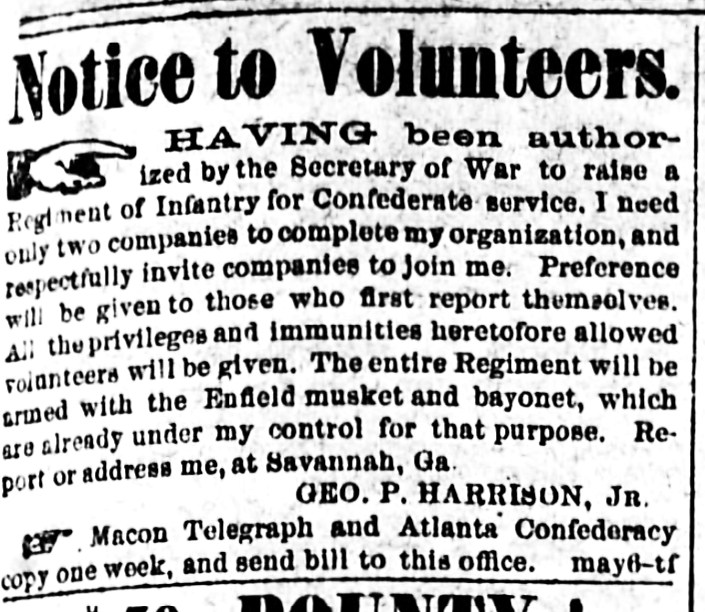 (Daily Morning News, May 13th, 1862)