 |
|||||||||||||


 |
|||||||||||||
|
The following historical information is about the service of both the company, regiment, and the men, of the One Hundred and Eighteenth (118th) Illinois Infantry Regiment, U.S. Volunteers, which served in the American Civil War from November 1862 to October 1865. If you have any corrections, suggestions, or additional information that you wish to contribute, feel free to submit the information to the Webmaster.
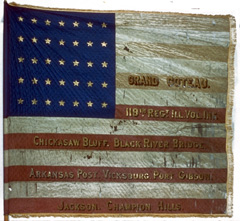
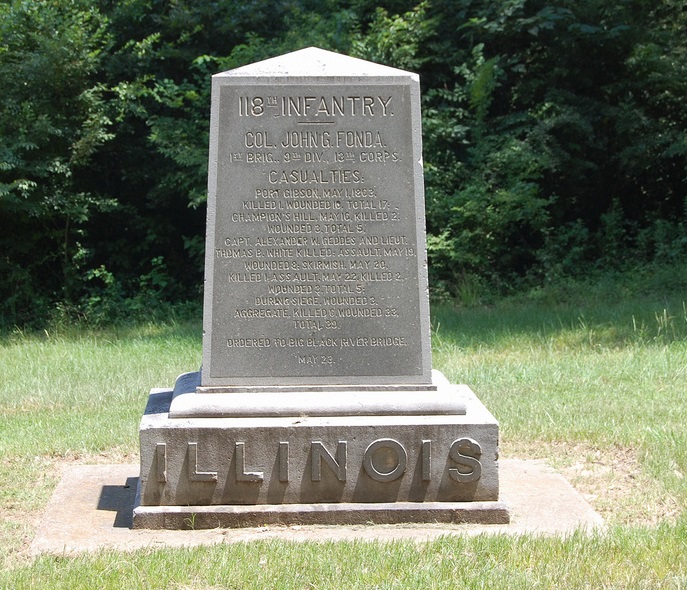
The troops composing this regiment enlisted under the call of the President of July 2nd, 1862, and the companies were formed during August of 1862, from the following places and counties: Company A, Captain Thomas J. Campbell, Fountain Green; Company B, Captain R. W. McClaughry, Carthage; Company C, Captain A. W. Marsh, Hamilton; Company E, Captain J.S. Allen, Warsaw; and Company H, Captain F. G. Mourning, Basco, all in Hancock county,--Company D, Captain J. H. Holton, Quincy; Company F, Captain W. J. Evans, Richfield, and Company K, Captain J. D. Rosenbook, Mendon, Adams county; Company G, Captain Joseph Shaw, Terre Haute, Henderson county, and Company I, Captain Charles During, Gallatin county. The companies rendezvoused at Camp Butler during the month of September 1862, and were respectively sworn into the service of the State by Adjutant General Fuller, and organized into a Regiment. In October an election was held for the Regimental officers, at which time Major John G. Fonda, of the Twelfth Illinois Cavalry Regiment, then commanding Camp Butler, was selected Lieutenant Colonel, Captain R.W. McClaughry, Major, Madison Reece, Surgeon, J. K. Boude, Assistant Surgeon, W. K. Davison, Quartermaster, and Thomas M. Walker, Chaplain. The Regiment remained on duty in charge of the post and guarding rebel prisoners until December. It was mustered into the United States service on the 7th of November 1862, by Captain Washington, for three years service, with a total of 820 officers and men. On November 21st, it was armed with Enfield Rifles. On November 29th, Lieutenant Colonel Fonda was promoted to Colonel, and Captain Thomas Logan, of Company G, Twelfth Illinois Cavalry, was made Lieutenant Colonel. On December 1st they left by the Chicago and Alton Railroad for Alton, Illinois, and there by boat to St. Louis, Missouri and below, arrived at Memphis, Tennessee, and went into camp on the Wolf River. Here the Regiment was assigned to the First Brigade (Colonel Sheldon, Forty-second Ohio commanding) Third Division, General G. W. Morgan, and the Thirteenth Army Corps of the Army of the Tennessee. While here they received their first tents, first watery beds, first "powder and ball" cartridges, its first scare, first "turn out for firing on the pickets," and first introduction to rebel jay hawkers, in a day and night skirmish. On December 20th, embarked on the steamer "Northerner" with the forces under General William T. Sherman, for Vicksburg, Mississippi. Reached Milliken's Bend on December 25th, and the following day proceeded up the Yazoo River, and participated in the attack upon Chickasaw Bluffs, from the 26th of December to January 2nd, 1863. On January 2nd, after the troops had re-embarked, the Regiment while on boat was under a heavy fire from a rebel line. From here proceeded with the force under General McClernand to Arkansas Post, Arkansas, and took part in the two days fight at that place on January 10th and 11th, 1863, which resulted in the capture of the fort and some 6,000 prisoners. On January 23rd, returned to Young's Point, Louisiana, where it assisted in the digging of the famous "canal," and remained until March 9th, when it moved to Milliken's Bend and went into camp. The Regiment was now Brigaded with the Forty-ninth and Sixty-ninth Indiana, One Hundred and Twentieth Ohio, Seventh Kentucky, First Wisconsin and Seventh Michigan Batteries and part of the Third Illinois Cavalry, as the First Brigade, General T.T. Garrard commanding, Ninth Division, General P.J. Osterhaus, and Thirteenth Army Corps, General John A. McClernand. On April 2nd, 1863, moved out in the expedition against Vicksburg under General Grant, crossed the Mississippi River at Bruinsburg on April 30th, and took part in the battle of Thompson's Hill (Port Gibson) on May 1st, at Champion Hill on May 16th, at Black River Bridge on May 17th, and in the assault upon Vicksburg from May 19th to 23rd; in the former two and the latter two suffering severely in killed and wounded; in the battle of Black River Bridge, a whole rebel regiment was captured by, and surrendered to Company D, commanded by Captain Brown. On May 24th, moved with General Osterhaus' Division to the Black River Bridge, and there remained until the surrender of Vicksburg, holding the rear against rebel General Joseph E. Johnston's forces, having frequent skirmishes with them. About June 10th, a Battalion of the Regiment was mounted by order of General Grant. On July 6th, started with force under General Sherman to Jackson, Mississippi, and took part in the fighting and siege from the 10th to the 17th, and from the 17th to the 20th. The mounted portion of the Regiment went on a raid to Brookhaven, a distance of 60 miles, and back, having frequent skirmishes, tore up the railroad and burned the rolling stock and depot buildings. On July 22nd, started for Vicksburg, where it arrived on July 25th, and went into camp on the flats below the city. While here the Regiment was dismounted and its horses turned over to the Quartermaster's Department, and the Regiment with the Thirteenth Army Corps was turned over to the Department of the Gulf. On August 8th, left by boat for Port Hudson, where it went into camp the next day. Remained there until August 15th. Shipped for Carrollton, Louisiana, and encamped there on the 16th. On September 4th joined in a grand review of the 20,000 troops, by General Grant and Banks. On September 5th, crossed the river to Algiers, on the 6th, took cars for Bayou Boeuf, where arrived the morning of the 7th. On September 16th, marched to Brashear City on Berwick Bay. On September 26th, crossed Berwick Bay to Berwick City. On October 3rd, started with an expedition under General Franklin up the Teche Bayou, at Camp Bisland, that night received orders to report to General A.L. Lee, chief of cavalry, Department of Gulf, at Algiers, Louisiana. On October 6th took the boat to Brashear, and cars to Algiers, arriving there on the morning of October 7th. The Regiment having been again mounted, on October 11th, returned by cars to Brasheaar, crossed the bay and started on the march. On October 12th, marched to Franklin, Louisiana, on the 13th to New Iberia. On October 14th, rejoined the main force and the Corps (Thirteenth). On October 15th, passed Vermillionville, having a heavy skirmish, and at night reached "Carrion Crow Bayou." On October 16th, 17th, 18th, 19th and 20th, scouting and skirmishing. On October 18th, Colonel Fonda was assigned to the command of the Brigade composed of the One Hundred and Eighteenth Illinois Mounted Infantry, Second Illinois, Fourteenth New York and First Louisiana Cavalry. On October 21st, marched to Opelousa, skirmishing all the way. From October 22nd to 30th, scouting and skirmished with the rebels. On November 1st, moved back to Bayou Bourbent, or Carrion Crow Bayou, or Grand Goteau, as it is known. On November 2nd, heavy skirmishing. November 3rd, in the battle of Carrion Crow Bayou, or as sometimes called Grand Goteau, in which our forces lost two regiments and a battery, and about 108 to 150 men killed and wounded. On the 5th, reached Vermillion Bayou. On the 7th, re-brigaded with Second and Third Illinois Cavalry under command of Colonel Fonda. November 11th, battle near Vermillionville, in which lost severely. November 15th, moved to New Iberia. November 22nd and 23rd, on a scout to Vermillion Bayou, heavy fight and captured 100 prisoners. December 2nd and 3rd, scout to St. Martinsville, heavy skirmish and took some prisoners. Remained at New Iberia taking part in daily scouts and skirmishing until December 18th, when received orders to march to Donaldsonville, Louisiana. On December 23rd, halted at General Bragg's plantation, at night camped on Senator Pugh's plantation--sorry the gentlemen were not at home--but entertained ourselves with the delicacies thereof, reached Donaldsonville on the Mississippi on December 24th. January 3rd to 7th, 1864, the Regiment was transferred to Port Hudson. For some time the Regiment was without tents or shelter, in the mud, rain and snow, and suffered intensely, remained here doing outpost duty and scouting and skirmishing almost daily, until July 3rd. January 12th, on a scout, had a skirmish, and captured a number of prisoners. January 21st, received the first tents had since last August. February 10th, after a fight captured Jackson, Louisiana, with some prisoners and much property. February 16th, had a skirmish. February 22nd, a raid to Bayou Sara and a skirmish. March 3rd, Lieutenant Colonel Logan, with a detachment, went to Baton Rouge, and on the way had a skirmish, and Colonel Fonda with a detachment of the One Hundred and Eighteenth and the Third Illinois Cavalry made a raid to Jackson, Louisiana, and had a severe fight. March 26th, detachments of the Regiment had skirmishes; Company D, Captain Brown commanding, were entirely surrounded by rebels, but cut their way out taking some prisoners. March 28th, 30th, April 1st and 5th, had scouts and skirmishes. Early in April Lieutenant Colonel Logan, with about 150 men from the One Hundred and Eighteenth and Third Illinois Cavalry, crossed the Mississippi River to superintend the construction of telegraphic lines to Red River, made a scout to Bayou Gross Tete, encountered a largely superior rebel force, and after a determined saber charge had a hand-to-hand fight, routed the rebels, killing and wounding a large number, captured a large quantity of ammunition, stores, etc., captured more prisoners than he had men in his command. April 7th, Captain Shaw with 100 men of the One Hundred and Eighteenth and Third Illinois Cavalry and one gun of a New York battery were attacked by 600 rebels, surrounded, and three time cut off from camp. After a desperate fight they succeeded in cutting their way out and reached camp with a loss of only 15 men and the gun. On May 15th, had a several hours fight with a large force of rebel cavalry, in which they killed and wounded several, and recaptured some prisoners they had before taken. Kept up the telegraph to the mouth of Red River until the failure of the Banks expedition, and while so doing companies A, B and F were on May 3rd, cut off by the rebels, and relieved by the gunboat General Bragg. On June 13th and 17th, had skirmishes. On July 3rd, moved to Baton Rouge, and were re-brigaded with the Sixth Missouri, Fourteenth New York and Second Louisiana Cavalry, under command of Colonel Fonda. From August 24th to 27th, with the command of General A.L. Lee, went to Clinton, Louisiana, on which we were fighting parts of two days and all one night, having a battle at the Comite River; and on the 26th, repeatedly charged the rebel column, fighting for miles. On September 4th, marched to Doyal's Plantation, and September 7th, to Hermitage plantation, opposite Donaldsonville, to relieve the Eleventh New York Cavalry. From here scouted the surrounding country almost daily, and fought bushwhackers and captured many. On September 14th, October 2nd, 14th and 24th, had skirmishes. OnNovember 12th, 200 of the Regiment, under Captain Evans, reported to General Lee, at Baton Rouge, and on the 15th, left with his command on a raid to Liberty, Mississippi. Part of the Regiment went with a detachment to Summit, on the Jackson and New Orleans Railroad, having a severe skirmish, and burning depot and cotton. A party went with a detachment to Brookhaven, had a fight, re-captured cannon taken from Captain Shaw, on April 7th, and took many prisoners, and the remainder were in battle with General Lee, at Liberty. On November 19th, returned to Baton Rouge. On November 21st, having been gone some seven days, marched 200 miles, and with other forces captured one cannon and over two hundred prisoners, and fought five of the seven days. On November 24th, moved from Hermitage to Baton Rouge. On November 27th, left on an expedition under General Davidson, which marched across the Amite River, past Greenville Springs, Greensburg, Tanglpahoe, across Tanglpahoe and Techfaw River, through Columbia and Bogue Chitto, Mississippi, over Pearl River, near Augusta, Alabama, across Red and Black Creeks, and reached West Pascagoula, on Mississippi Sound, on December 12th. During several days of this march, had skirmishes. Returned by vessel to New Orleans, and by boat, to Baton Rouge, on December 27th, 1864. From this time to May 22nd, doing out-post duty, and almost daily scouts into the surrounding country, with frequent skirmishes with the rebels. On February 25th, Lieutenant Colonel Logan, with the Regiment, made an expedition west of the Mississippi River. From March 1st to 10th, in an expedition under General Bailey, to Olive Branch, Louisiana. On May 22nd, 1865, by order, turned the horses over to the Post Quartermaster, and from that time until October 1st, remained on provost duty at Baton Rouge. Colonel Fonda commanded a Cavalry Brigade from October of 1863 until May of 1865. On June 28th, 1865, he was Brevetted to the rank of Brigadier General of United States Volunteers, and assigned to the command of the District of Baton Rouge, Louisiana, which command he held until October of 1865. In September of 1865, almost the entire Regiment had the "breakbone fever," and at one time, less than a hundred men and officers being able to do duty. On October 1st, 1865, the regiment was mustered out of United States service by Lieutenant E.M. Schuyven of the First New Orleans Volunteers. On October 2nd they embarked on the steamer “W.R. Carter,” for the North. Reached Cairo, Illinois, on October 8th, St. Louis, Missouri, on October 9th, thence by railroad to Camp Butler, on October 10th, 1865, where the Regiment was mustered in on November 7th, 1862. Were paid off by Paymaster Major Holbrook, on October 13th, 1865, and the Regiment thence disbanded and forever separated. The number of battles, or days of battles, in which the Regiment or a considerable portion was engaged amounts to over forty. The number of skirmishes in which the Regiment or a detachment took part, outside of mere picket skirmishing, is over sixty; making over one hundred days in which some portion of the Regiment was engaged with the enemy. The movements by railroad of the Regiment, aggregate some four hundred miles; by steamboat and vessel 3,300 miles, and the marches of the Regiment, as a body, irrespective of what would be termed "scouts," or little expeditions of the Regiment or detachments thereof, about 2,000 miles, making a distance traveled by the Regiment of over 5,700 miles. The Regiment was mustered into service with 800 officers and men; it received 283 recruits, making a total of 1,103; when mustered out on October 1st, 1865, it numbered 523 officers and men. The losses were as follows: 267 resigned and discharged for disability; 176 died; 63 missing; 17 killed in battle; 1 dishonorably discharged; 2 accidentally killed; 1 lost at sea; 2 drowned; 1 committed suicide; 7 absent at muster; 3 discharged by the President; 1 dismissed the service, and 25 transferred to other branches of the service, leaving 14 unaccounted for. This statement does not include 36 mustered under cooks, and 25 unassigned recruits who never reached the Regiment.
|
|||||||||||||
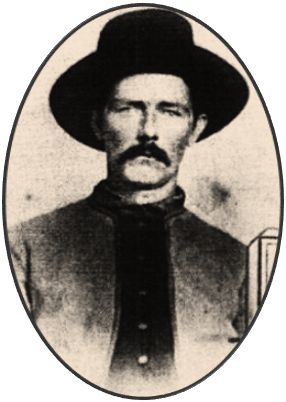 Corporal Franklin C. BennerCompany C(Military Images)
 Research Pending